

2026-11-20
Why Do Porcelain Veneers Keep Breaking? The Problem May Not Be the Ceramic
Written by Dr. Agatha Bis
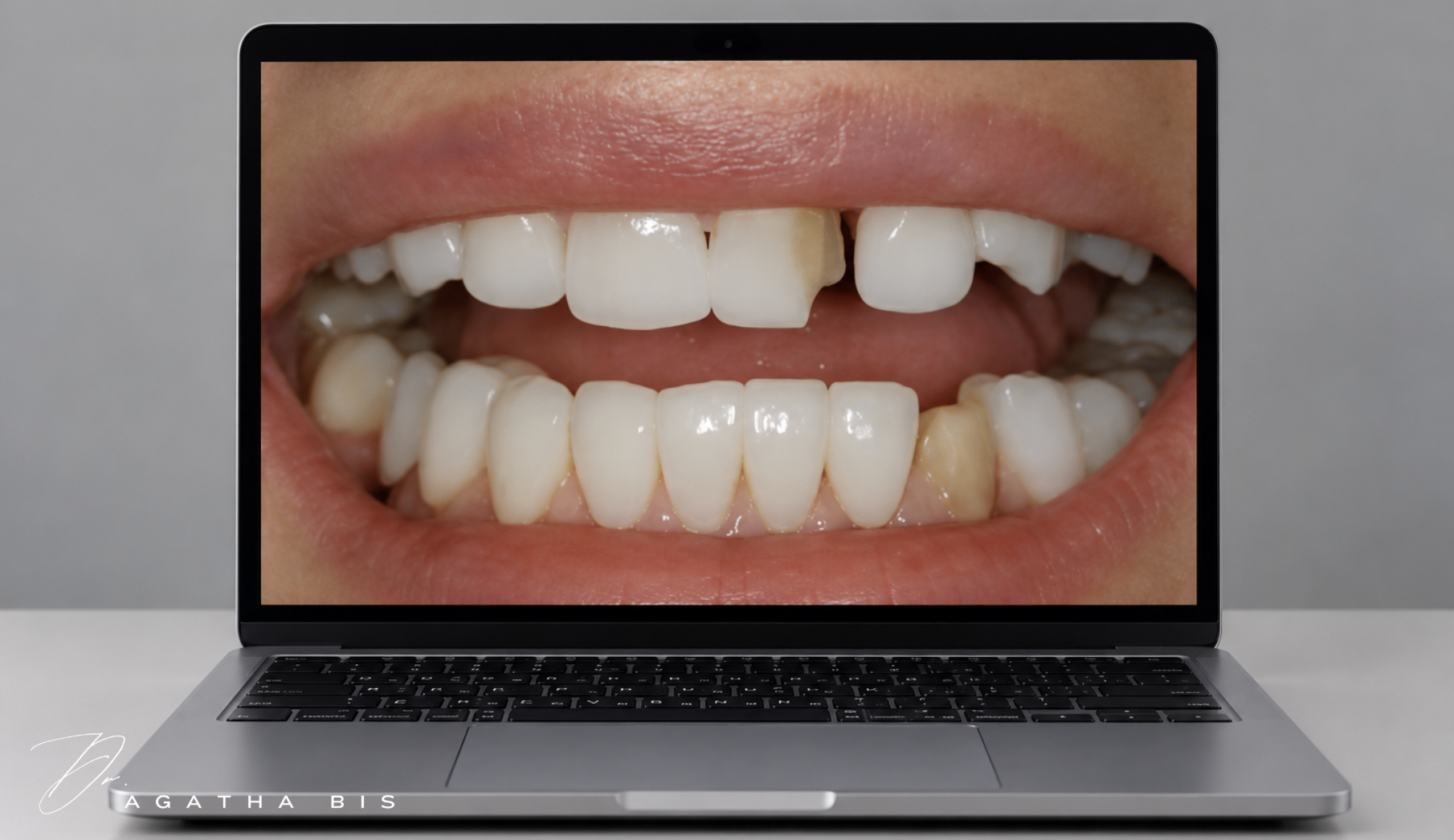
You place a veneer, the esthetics are excellent, the margins are accurate, and the bonding protocol was followed correctly. Six months later, the patient returns with a fracture. You replace it, but the same thing happens again.
At what point do we stop questioning the ceramic and start questioning the forces acting on it?
In my experience, repeated restorative failures often reveal something that was not fully understood during the initial diagnosis.
A Veneer Is Only as Stable as the System Supporting It
When a veneer fractures, we naturally review the preparation design, ceramic thickness, enamel availability, and adhesive protocol. These are essential considerations, but they are only part of the picture.
The anterior teeth guide mandibular movement. Changing their length or lingual contour can alter anterior guidance, contact timing, and the path the mandible follows during closure.
A restoration may be technically correct and still function poorly if the underlying system is unstable.
Research supports the importance of considering functional risk. A systematic review and meta-analysis by de Souza Melo et al. found increased odds of failure in anterior ceramic veneers among patients with sleep bruxism [1].
What Was Happening Before the Veneer Was Placed?
Consider a patient with shortened anterior teeth, significant wear facets, and repeated composite fractures. We restore the lost anatomy to improve esthetics, but have we established why that anatomy disappeared?
Tooth wear may reflect years of mechanical loading, chemical erosion, or several processes occurring together. It also does not necessarily mean the patient has lost vertical dimension.
If we restore incisal length without understanding the available restorative space and the existing closing path, we may introduce contacts that interfere with comfortable mandibular movement.
The next veneer is then functioning in the same mechanical environment that contributed to the original breakdown.
Stop Replacing the Damage Without Investigating the Cause
Before repeating a failed restoration, I want to understand the wear pattern, muscle activity, anterior guidance, mandibular closure, and joint condition.
This does not mean every fractured veneer is caused by TMJ dysfunction. It means we should not assume that every failure is an adhesive or material problem.
The question is not only how to make the restoration stronger. It is whether we understand the forces it must withstand.
I examine this relationship in greater detail in my scientific article, Cosmetic Dentistry on an Unstable Foundation, including the role of anterior guidance, condylar position, and functional risk.
Take This Further in Clinical Practice
In Hands-On Level 1: Screening, Examination, and Diagnosis, we start by learning to identify the clinical findings behind restorative breakdown.
In Hands-On Level 2: Occlusion and Treatment Planning, we connect those findings to occlusal forces, mandibular position, and comprehensive restorative decisions.
Explore Hands-On Level 1 | Explore Hands-On Level 2
References
de Souza Melo G, et al. Association of sleep bruxism with ceramic restoration failure: a systematic review and meta-analysis. J Prosthet Dent. 2018;119(3):354–362.
Morimoto S, et al. Main clinical outcomes of feldspathic porcelain and glass-ceramic laminate veneers. Int J Prosthodont. 2016;29(1):38–49.
Loomans B, et al. Severe tooth wear: European consensus statement on management guidelines. J Adhes Dent. 2017;19(2):111–119.